AI architecture
From GenAI Demo to Production: Reusable Architecture Patterns on AWS and OCI
Reusable architecture patterns for moving enterprise GenAI systems from impressive demonstrations to dependable production systems.
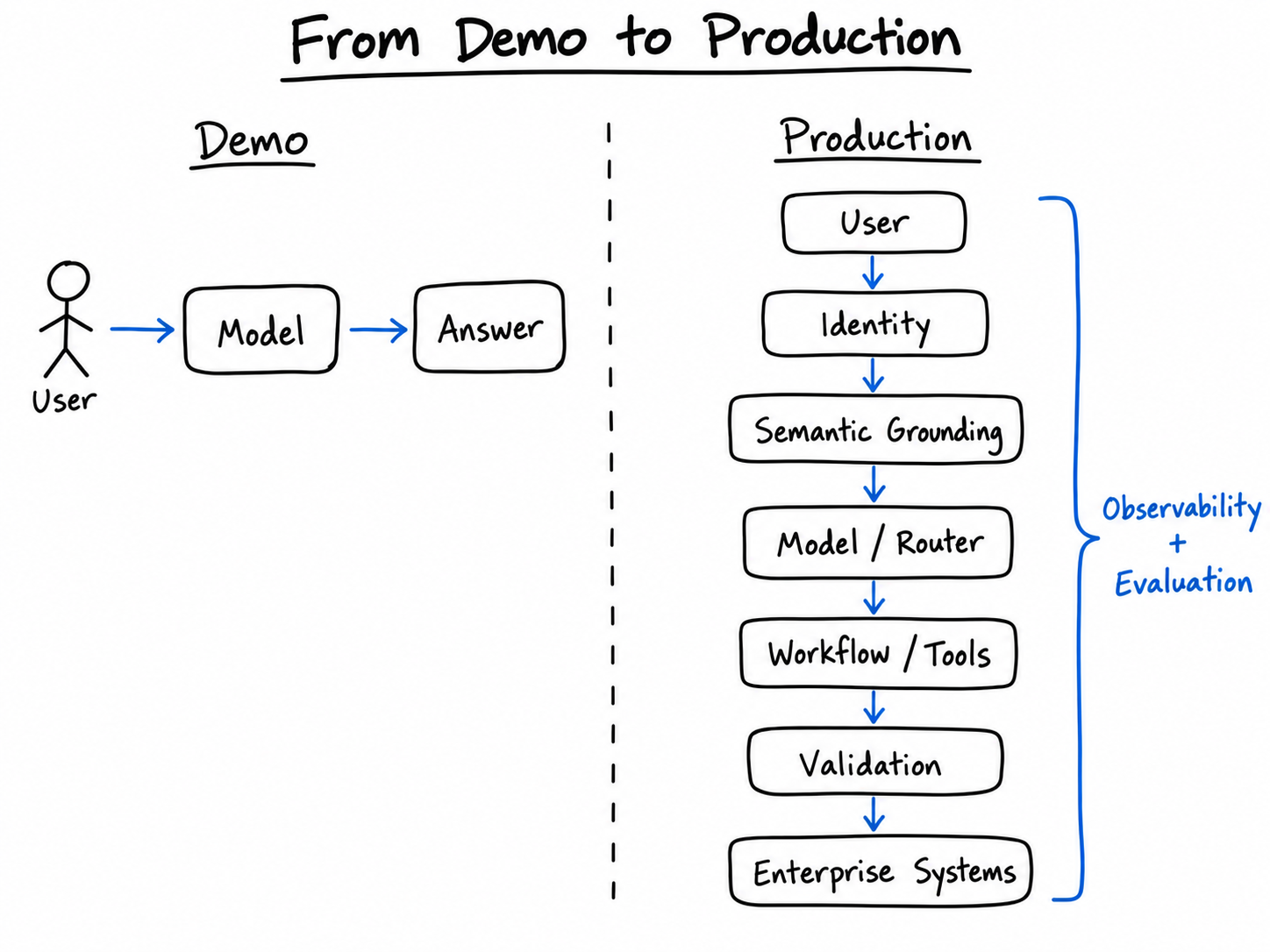
Generative AI demonstrations create momentum because they make capability visible very quickly. A model can answer a question, generate SQL, recommend a product, or guide a user through a transaction after a relatively small amount of integration work. That early success often creates the next management directive: add agents, connect more systems, support more users, and move the capability into production. The architecture changes at that moment because the system must now carry business value, operational risk, and user expectations rather than simply prove that the idea works.
The production gap usually reveals itself through production realities. Data lives in transactional schemas designed years before GenAI existed, business rules have accumulated across applications and spreadsheets, legacy systems have hard scaling limits, and the user journey crosses several APIs owned by different teams. A live interaction also introduces latency, state, retries, authorization, and the need to explain what happened when an answer is wrong. Production readiness is therefore the engineering required to fit AI into the actual shape of the enterprise.
The examples in this article are fictionalized composites based on architecture problems I have encountered in enterprise projects. Consider a quick-service restaurant building a conversational drive-through assistant, a retailer using AI to help merchandisers bundle related products, a university creating a natural-language course-search and registration experience, and a manufacturer giving its CFO conversational access to sales and financial data. The industries differ, but the same architecture patterns appear repeatedly. Those patterns provide a useful framework for solution architects moving GenAI from demonstration to production.
Pattern 1: Build a Semantic Grounding Layer
Enterprise AI needs a representation of the business that matches the language users actually speak. Operational databases are generally organized around transactions, application logic, and data integrity, while users think in concepts such as "bridal jewelry," "evening wear," "classes after 11," "margin by region," or "make that a large combo." The semantic distance between those two worlds becomes an engineering problem as soon as the application moves beyond a curated demonstration. A semantic grounding layer closes that distance by shaping enterprise data into concepts the model can use reliably.
A jewelry retailer illustrates the problem well. Its complete catalog may live in a highly normalized Oracle transactional database, while the warehouse contains only part of the merchandising detail. A useful bundling assistant needs to understand attributes such as gemstone, metal, color, style, bridal, evening, occasion, price range, and perhaps dozens of other characteristics that were never designed as an AI taxonomy. The first production task is therefore classification and abstraction: specific product attributes have to be generalized into categories that place related products in the same conceptual neighborhood.
Vector embeddings become useful after that semantic work has been done. A product can be represented through a curated combination of attributes, embedded into a vector, and compared with other products through cosine similarity to identify plausible candidates for bundling. The technique resembles geographic roll-up: a local street belongs to a neighborhood, a town, a county, and a state, and each level creates a broader notion of proximity. Product semantics work the same way; meaningful similarity depends on choosing the right level of abstraction before computing distance.
A practical implementation begins by identifying the business vocabulary users actually use and mapping it to authoritative enterprise data. Transactional tables can be reshaped into denormalized views or semantic entities, categorical values can be normalized into broader taxonomies, and important textual representations can be embedded for similarity search. Metadata such as source, version, effective date, business unit, security classification, and entitlement should travel with the AI-facing representation so retrieval can be filtered before model invocation. The model then reasons over a curated semantic surface rather than discovering the enterprise schema from scratch on every request.
AWS can implement this pattern with Amazon Bedrock Knowledge Bases, Amazon S3, supported vector stores such as OpenSearch, metadata filtering, semantic or hybrid retrieval, and reranking where appropriate. Bedrock Knowledge Bases supports retrieval filters over metadata attributes before results are returned, which lets applications constrain retrieval using business attributes or access-related metadata.
OCI offers a strong structured-data implementation because Oracle AI Vector Search in Oracle AI Database 26ai can combine vector similarity with relational and hybrid search. OCI Generative AI also supports File Search and vector-store capabilities through the Responses API, while SQL Search is available separately for NL2SQL-oriented use cases. The important architectural choice is to place semantic preparation between raw enterprise data and model reasoning, regardless of which retrieval service performs the final search.
RAG is one implementation of a broader semantic-grounding pattern. A document repository, product catalog, restaurant menu, financial data mart, or transactional schema all require an AI-facing representation of enterprise meaning before reliable reasoning can occur.
Pattern 2: Turn Natural Language into Deterministic Execution
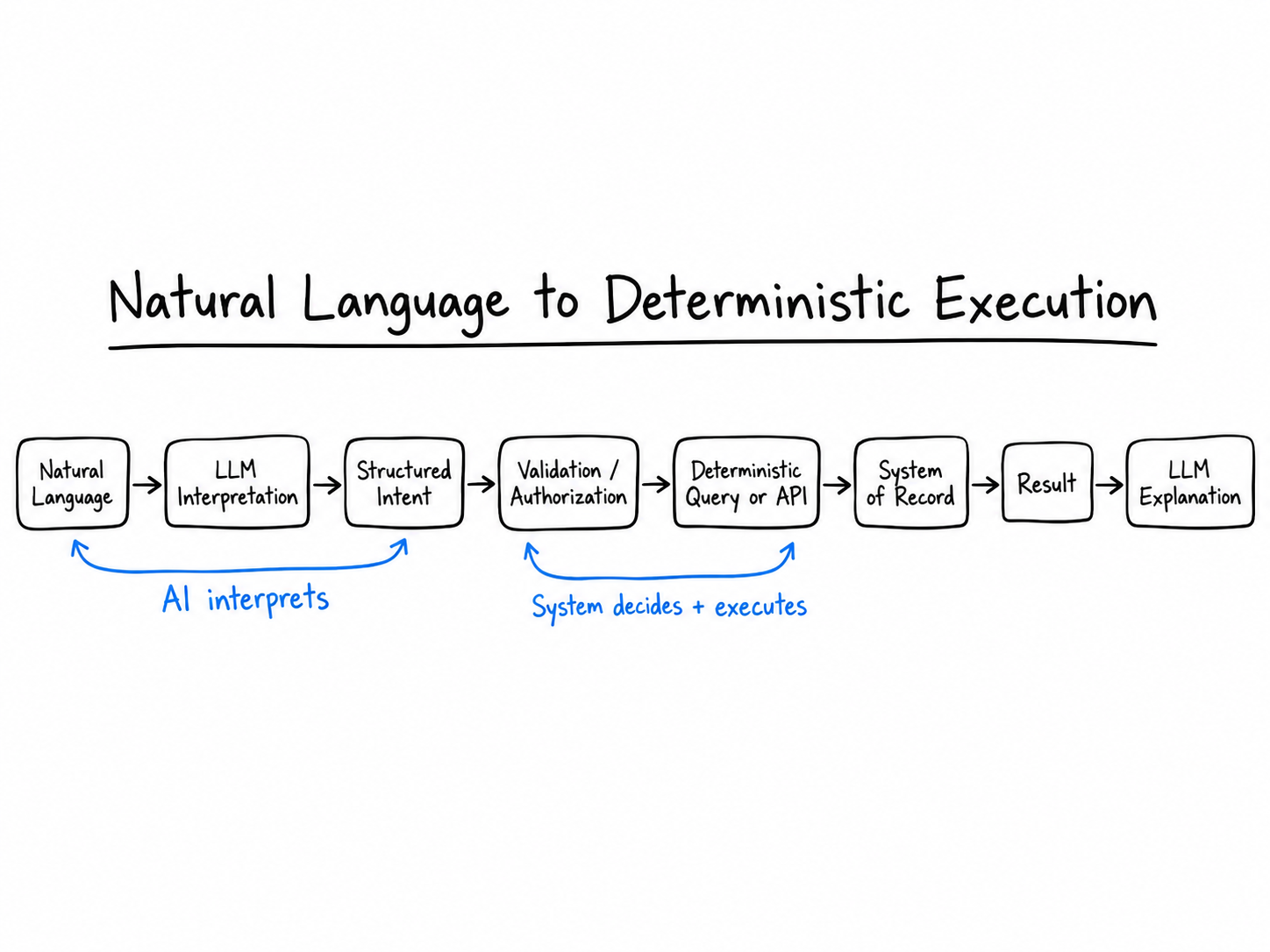
Natural language creates an expressive interface to structured systems. A student can ask for classes on Tuesday and Thursday after 11, a CFO can ask which regions grew revenue while losing margin, and a merchandiser can ask for products that belong in the same look. The model can extract intent, filters, entities, and relationships from those questions very effectively. Production accuracy then depends on how that interpreted intent is converted into SQL, API calls, and business actions.
A broad NL2SQL demonstration often looks impressive because the model can generate syntactically sophisticated SQL from plain English. Enterprise schemas introduce harder requirements: business terms may have specialized definitions, joins may span many normalized tables, row-level access may vary by user, and a query can be syntactically valid while producing the wrong answer. A financial question such as "Which product lines are losing margin despite revenue growth?" contains several assumptions about revenue recognition, margin calculation, comparison period, product hierarchy, and filtering. Those assumptions have to be engineered into the query path.
A trustworthy architecture therefore uses the model to convert language into a constrained semantic representation. The output might be an intent, a metric, a period, a hierarchy level, or a set of search parameters. A deterministic service then maps those parameters to approved query templates, APIs, stored logic, semantic models, or validated SQL builders, applies authorization and business rules, executes the operation, and returns structured results. The model can summarize or explain the result afterward, while the data-access path remains testable and reproducible.
This pattern also applies to actions. A model may interpret "change my payment date to the 15th" correctly, but the backend still owns account validation, eligibility, authorization, effective-date rules, and idempotency. Tool schemas constrain the actions a model can request; application services determine whether those requests are allowed to execute. The architecture preserves conversational flexibility at the edge while keeping enterprise truth and consequences under deterministic control.
A practical implementation begins by defining a small set of supported intents or business operations and the structured parameters required by each. The LLM produces that structure rather than arbitrary executable code, and a service layer validates the structure against identity, permissions, business rules, and known schemas. Approved query builders or APIs then perform the actual work, with results passed back to the model for explanation if needed. As the application proves value, the supported intent library can expand without surrendering control of the execution path.
On AWS, this pattern can be implemented with Amazon Bedrock or AgentCore for model interaction, AgentCore Gateway for standardized tool exposure, Lambda or containerized services for deterministic validation, API Gateway for enterprise APIs, IAM for authorization, and Bedrock Guardrails as an additional safety layer. AgentCore Gateway uses MCP to provide a standardized mechanism for agents to discover and invoke tools, while the application remains responsible for the business semantics and authorization surrounding those tools.
OCI supports a similar architecture through the OCI Generative AI Responses API, which currently supports Function Calling and MCP Calling for tool-based workflows. Oracle also exposes SQL Search as a separate OCI-native NL2SQL capability rather than as a generic Responses API tool, which is an important implementation distinction for architects designing controlled structured-data access.
This pattern turns natural language into an entry point rather than an execution engine. The LLM interprets what the user means, while engineered services determine what the enterprise actually does.
Pattern 3: Make Conversation State Explicit
Conversational applications accumulate state from the first turn. A customer may add an item, change a modifier, revisit an earlier choice, accept a suggestion, or correct something the system misunderstood. Production reliability improves when that business state is represented explicitly through workflow variables and state transitions. The conversation then becomes an interface to a process whose current state can be inspected and controlled.
A drive-through ordering assistant makes this easy to see. The underlying menu may come from a legacy point-of-sale platform where products, modifiers, condiments, combinations, and promotions are represented through structures designed for restaurant operations. The customer speaks naturally, perhaps using slang or local product names, while background noise can distort speech-to-text. The application has to maintain the order accurately even as the customer says, "make that large," "change the side," or "actually remove the first drink."
Menu rules add another layer of state. Combos may require specific choices, certain modifiers may only apply to particular products, prices change with sizes and substitutions, and seasonal promotions alter valid combinations. These rules evolve independently of the model and need a stable representation that can be tested. An explicit state machine gives the architecture a durable place to record what has already happened and which transitions are valid next.
A practical implementation starts by defining the business states and transitions independently of the conversation. The LLM converts each user utterance into a proposed event such as ADD_ITEM, CHANGE_SIZE, or REMOVE_MODIFIER, while a state machine or workflow service validates that event against the current state and business rules. The resulting state is persisted after every successful transition, giving the next turn a known starting point. Long-running enterprise workflows can extend the same pattern with waits, retries, approvals, human handoffs, and compensating actions.
AWS commonly implements durable orchestration with Step Functions alongside Lambda, EventBridge, queues, or enterprise APIs. AgentCore can host or connect the reasoning component, while workflow state remains explicit in the surrounding application architecture. OCI can combine the Responses API and its conversation capabilities with Functions, OCI Queue, Events, ORDS, Oracle Integration, or application-managed workflow logic depending on process duration and complexity. OCI's Responses API supports stateful interactions, multi-step workflows, Function Calling, and MCP Calling, but durable business state should still be designed according to the needs of the process.
Human involvement fits naturally into the same pattern. A workflow can automate low-risk, high-confidence transitions, request confirmation for more consequential actions, and move a case to an employee when confidence, policy, or business risk requires judgment. Human escalation then becomes another designed state transition rather than an exception outside the architecture.
The reusable pattern is explicit orchestration. Conversation carries human intent forward; workflow carries business state forward.
Pattern 4: Isolate GenAI Workloads from the System of Record
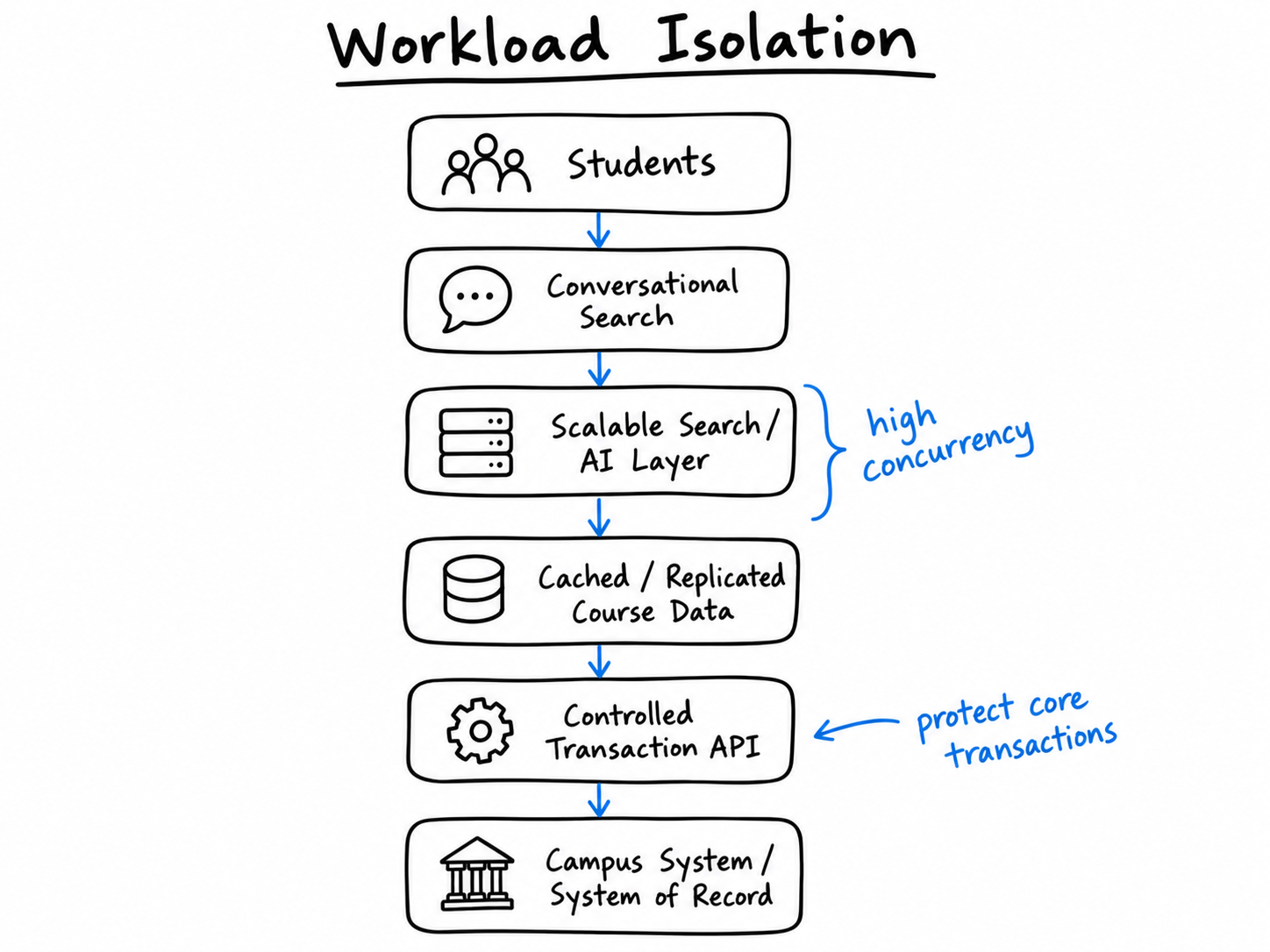
GenAI changes traffic patterns because conversational interfaces encourage exploration. A user may ask several variations of a question, compare alternatives, refine filters, and request explanations before completing one transaction. That interaction creates many more reads and model-driven searches than the final business event alone would generate. Production architecture needs a scalable layer that absorbs this demand before it reaches systems whose primary responsibility is transaction integrity.
A large university provides a useful example. Students may already struggle to search a complex campus-management interface, build schedules, compare sections, and identify courses that fit degree and time constraints. A natural-language assistant can simplify that journey dramatically by allowing questions such as "show me two classes for my major on Tuesday and Thursday after 11." The demand arrives during registration windows, when thousands of students may be searching and registering at the same time and the underlying campus system is already under intense pressure.
The architectural solution is workload isolation. Course and section data can be replicated, indexed, cached, or exposed through a purpose-built search layer designed for high concurrency, while the system of record remains authoritative for registration. Natural-language interpretation and search can scale horizontally in that outer layer, and only the final state-changing operation crosses a controlled transactional boundary. The pattern protects the legacy application while still allowing the new user experience to scale aggressively.
A practical implementation begins by separating read-heavy exploration from state-changing transactions. Frequently queried data can be copied into an AI/search-optimized store or exposed through independently scalable services, while caching handles stable or repeatedly requested information. Queues and backpressure mechanisms absorb bursts, and transactional APIs enforce validation, idempotency, and authorization when a request finally reaches the system of record. The architecture should also define acceptable staleness so the search layer can scale without creating misleading business decisions.
AWS can implement this pattern with combinations of SQS, EventBridge, Lambda, ECS/Fargate, DynamoDB, Aurora/RDS, OpenSearch, and Step Functions depending on the workload. OCI provides Queue, Streaming, Functions, OKE, Autonomous Database, Oracle Database, and Events for equivalent architectural responsibilities. OCI Queue is a managed serverless service designed to decouple systems and handle high-volume transactional messaging, and it includes dead-letter handling for repeatedly unsuccessful messages.
Latency belongs inside this pattern because isolation adds network and service boundaries. Solution architects should budget the complete interaction across authentication, retrieval, model inference, tool calls, APIs, and final generation, then measure P95 and P99 behavior rather than relying only on averages. Streaming, caching, smaller contexts, parallel retrieval, and selective use of faster models all become tools for protecting the experience as traffic increases.
The production goal is controlled elasticity. The conversational surface can expand with user demand while the transactional core remains protected and predictable.
Pattern 5: Control the Technology Footprint and Route Intelligently
GenAI systems can accumulate technology quickly. A live conversational application may involve speech services, a JavaScript front end, Python orchestration, Java backend services, Redis, a vector database, APIs, a workflow engine, a model provider, and a legacy system of record. Every added runtime creates another deployment surface, skill requirement, security boundary, network hop, and place where latency or failure can appear. Production architecture therefore includes deliberate control of the technology footprint.
A drive-through assistant demonstrates the operational cost of stack sprawl particularly well. A simple customer goal, place an order, can cross speech recognition, model inference, vector menu search, a combo-rule service, order APIs, caching, and the point-of-sale system before the customer hears the next response. Different APIs may use different payload conventions and error structures, forcing the orchestration layer to become custom glue. A feature that appears simple at the edge can require a surprisingly large team behind it.
Architecture simplification starts by drawing the complete request path and asking what each boundary contributes. Every runtime, framework, service, model call, and API hop has to justify its operational cost. Common capabilities should expose simpler contracts, redundant model calls should be removed, and services should be consolidated where specialization does not create clear value. MCP can provide a useful standardized tool boundary when multiple agents or model clients need shared access to the same capabilities, while conventional APIs remain appropriate where interoperability needs are simpler. The goal is fewer hops, lower latency, reduced staffing complexity, and a smaller execution path the operating team can actually support.
Model routing belongs here because every request does not require the same reasoning capability. A simple classification or factual lookup can often use a faster, cheaper model, while a complex comparison or tool-planning task can be sent to a stronger model. Routing decisions can consider task type, latency target, context size, risk, tool requirements, confidence, and cost. The routing policy itself should be versioned because changing the router changes application behavior even when every prompt and model remains unchanged.
A practical implementation should therefore treat the execution path as configurable architecture. Define a small number of model tiers, create explicit routing rules or classifier-based routing, standardize tool and API schemas, and instrument the number and duration of every hop. Version the routing policy, tool schemas, API contracts, and fallback behavior so changes can be tested and rolled back. Simplification becomes measurable when the team can see fewer calls, lower latency, fewer failure surfaces, and a smaller operational footprint.
AWS currently provides Intelligent Prompt Routing in Amazon Bedrock, which can route between supported models within the same model family based on predicted response quality and cost. AWS also notes limitations for application-specific cases, so solution architects may still choose their own routing layer when business risk, latency, or task semantics require additional signals. AgentCore Gateway can standardize tool access through MCP and can expose Bedrock Knowledge Bases as MCP-compatible tools.
OCI does not require an equivalent managed routing service for this pattern. Applications can implement routing explicitly while calling supported models through OCI Generative AI, and the Responses API provides a common interface for model interaction and supported tools. That difference is architecturally healthy: the pattern is intelligent model selection and standardized capabilities, while the cloud implementation can be managed, application-driven, or a mixture of both.
The reusable pattern is disciplined composition. Production systems become easier to scale and operate when every component earns its place in the request path.
Pattern 6: Make Every Change Observable, Evaluable, and Reproducible
Production systems eventually become complex enough that "the AI gave a bad answer" stops being a meaningful diagnosis. The failure could originate in transcription, semantic grounding, retrieval, routing, model reasoning, tool selection, workflow state, SQL construction, an API, or the underlying data. Troubleshooting requires visibility across the entire business interaction. Observability creates that chain of evidence.
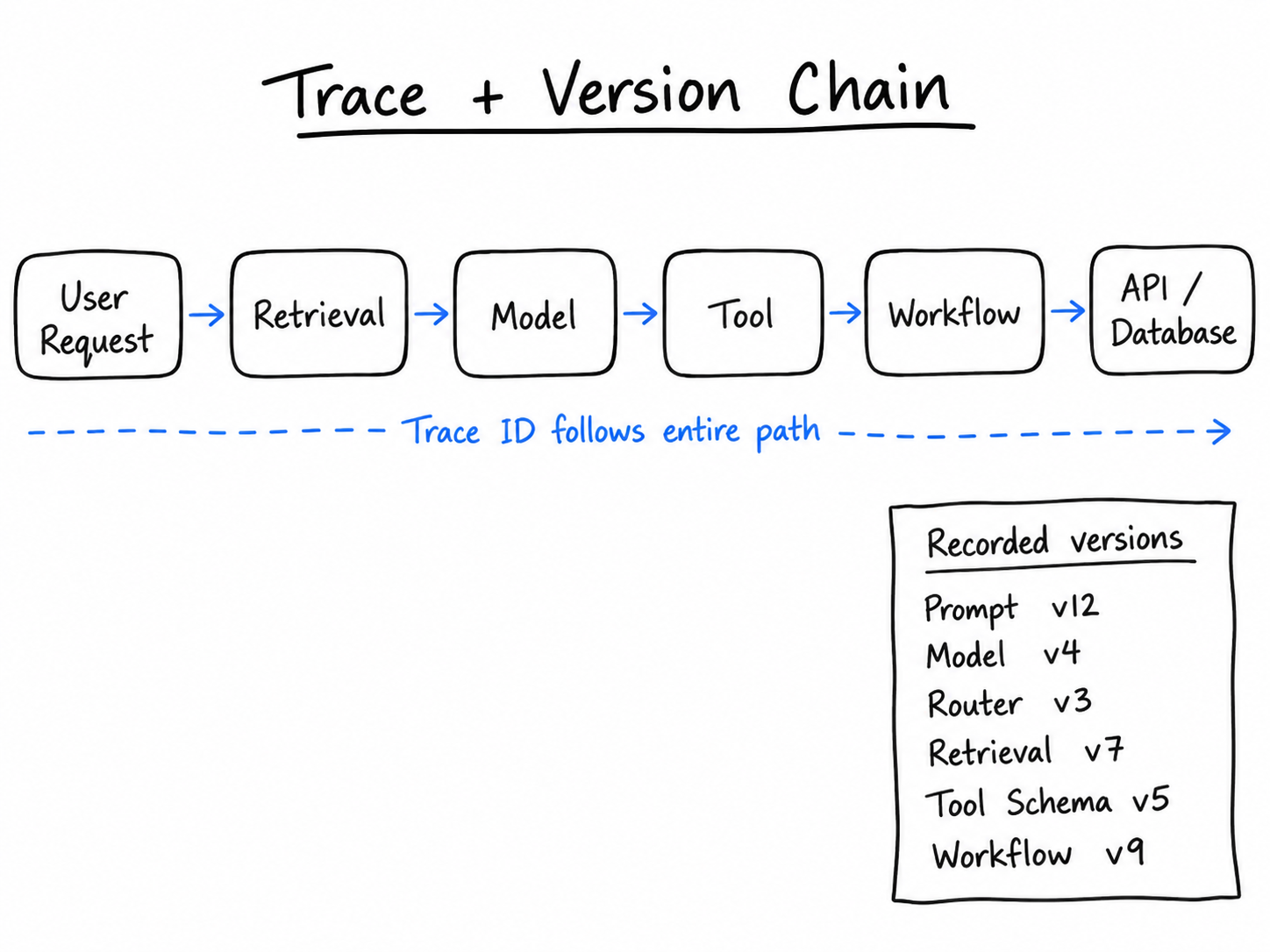
Distributed tracing provides the operational foundation. A trace ID created at the edge can flow through retrieval, model calls, tools, APIs, workflow services, and database operations, with each component producing a span. An engineer can then see whether latency accumulated in retrieval, inference, a business-rule service, or the system of record. OpenTelemetry is particularly valuable because the trace model remains portable across languages, runtimes, and clouds.
GenAI also requires behavioral versioning because the same application can change without a conventional code deployment. A prompt can change, a model can be upgraded, the router can send traffic differently, the embedding model can change, retrieval thresholds can move, or a tool schema can acquire a new parameter. A useful production trace should therefore record values such as prompt_version, model_id, model_version, routing_policy_version, semantic_model_version, embedding_version, retrieval_config_version, tool_schema_version, api_contract_version, workflow_version, and application_version. Reproducibility depends on knowing which combination produced the original behavior.
Evaluation turns those versions into an engineering feedback loop. A representative golden set can measure answer correctness, groundedness, retrieval relevance, tool-selection accuracy, parameter accuracy, task completion, authorization behavior, latency, and cost. Business-specific metrics then determine whether the system is actually useful: product recommendations accepted by merchandisers, accurate financial answers, successful course searches, or correct orders completed within an acceptable response time. Evaluation provides the baseline against which every prompt, model, router, tool, and retrieval change can be judged.
A practical implementation begins by propagating a trace ID through the complete request path and attaching the relevant configuration versions to every interaction. Store metrics and traces for latency, tokens, tool usage, failures, and business outcomes, then build a regression suite from representative real-world cases. Changes should progress through offline evaluation, internal testing, pilot traffic, canary deployment, and gradual rollout with explicit success and rollback thresholds. The operating model should make it possible to reproduce a failed interaction, identify the layer that failed, change that layer, and prove that the change improved the system.
AWS AgentCore Observability currently emits OpenTelemetry-compatible telemetry and integrates with Amazon CloudWatch for sessions, latency, duration, token usage, errors, traces, and workflow inspection. AWS also supports ADOT-based instrumentation when teams need additional application-level spans or when agents run outside AgentCore Runtime.
OCI Application Performance Monitoring supports traces and spans and can ingest OpenTelemetry telemetry from heterogeneous applications. Oracle's guidance shows end-to-end context propagation and correlation between APM traces and Logging Analytics using TraceId and SpanId, which is especially useful when a GenAI request crosses Java, Python, Node.js, APIs, and database services.
This final pattern closes the production loop. A system becomes manageable when its behavior can be seen, reproduced, measured, changed, and compared against a known baseline.
Security and Governance Run Through Every Pattern
Security works best as a property of the architecture rather than a final layer added after implementation. Grounding needs entitlement-aware retrieval, deterministic execution needs authorization, workflows need approval boundaries, workload isolation needs controlled transaction paths, tool interfaces need least privilege, and observability needs auditability without leaking sensitive data. Data minimization should also determine how much enterprise context reaches the model in the first place.
Prompt injection illustrates why these responsibilities have to remain layered. User input, retrieved documents, web content, tool responses, and even apparently trusted enterprise text can contain instructions that attempt to redirect model behavior. Amazon Bedrock Guardrails currently includes prompt-attack detection for categories including jailbreaks, prompt injection, and prompt leakage in supported tiers, but AWS also documents that tool results are not automatically evaluated by the prompt-attack filter. The backend therefore still has to validate authorization, tool parameters, and business rules before consequential actions execute.
The same architectural principle applies on OCI or any other platform. The model interprets potentially untrusted inputs; deterministic controls decide what data may be retrieved and what actions may proceed. Security becomes stronger when authority remains explicit throughout the path.
Pattern-to-Service Mapping
The table below maps architectural responsibilities rather than claiming exact product equivalence.
| Production pattern | AWS examples | OCI examples |
|---|---|---|
| Semantic grounding | Amazon Bedrock Knowledge Bases, S3, OpenSearch, embeddings, metadata filtering, reranking | OCI Generative AI File Search/Vector Stores, Oracle AI Vector Search, Oracle AI Database 26ai |
| Deterministic execution | Amazon Bedrock/AgentCore, AgentCore Gateway, Lambda, API Gateway, IAM, backend services | OCI Responses API, Function Calling, MCP Calling, SQL Search, Functions, API Gateway, ORDS |
| Stateful workflow | Step Functions, EventBridge, SQS, Lambda, AgentCore | Responses API conversations, Functions, Queue, Events, Oracle Integration/application workflow |
| Workload isolation | SQS, EventBridge, ECS/Fargate, Lambda, DynamoDB/Aurora, OpenSearch | OCI Queue, Streaming, Functions, OKE, Autonomous Database, Oracle Database |
| Architecture simplification and routing | Bedrock Intelligent Prompt Routing, AgentCore Gateway, MCP, application routing | Application-level model routing, Responses API, Function Calling, MCP Calling |
| Observability and versioned change | AgentCore Observability, CloudWatch, ADOT/OpenTelemetry | OCI APM, Monitoring, Logging Analytics, OpenTelemetry |
The table is intentionally asymmetric. AWS currently provides managed Intelligent Prompt Routing, while OCI applications may implement model routing in their own orchestration layer. OCI can place vector and relational search close together inside Oracle AI Database, while AWS often composes retrieval through Bedrock Knowledge Bases and supported vector stores. Architecture should follow the enterprise context rather than forcing service symmetry.
What Changes Across Clouds, and What Does Not
Cloud services evolve quickly. AWS is building AgentCore around production agent runtime, gateways, identity, policy, and observability, while OCI currently positions the Responses API as the primary OpenAI-compatible API for most new agentic applications and supports File Search, Function Calling, Code Interpreter, MCP Calling, stateful interactions, and multi-step workflows. Those service boundaries will continue to move as both platforms mature.
The production questions remain remarkably stable. What business problem are we solving? What semantic representation does the model need? Which parts of execution require deterministic control? Where does workflow state live? How much load can the system of record absorb? Which model should handle each class of request? How many services can the team operate reliably? Which versions produced this response, and can we reproduce it six weeks later?
Those questions form the durable architecture. A cloud service can make one responsibility easier to implement, but it cannot remove the responsibility itself.
From Demo to Production
A GenAI demo proves that an intelligent capability is possible. Production engineering gives that capability a dependable place inside the enterprise. The work involves building a semantic representation of business reality, translating natural language into controlled execution, preserving state through workflows, isolating legacy systems from new demand, controlling architecture complexity, and creating an operational feedback loop around every change.
This progression also changes how teams should approach GenAI initiatives. "Build an agent" is a technology direction; "reduce the time merchandisers spend assembling compatible product bundles" is an engineering problem with a measurable outcome. "Use NL2SQL" describes a technique; "let a CFO answer ten recurring profitability questions accurately in seconds" defines value that can be designed, tested, and expanded.
For solution architects, reusable patterns provide a way to resist the pressure to design around the technology of the moment. Models, APIs, and managed services will continue to change. The production responsibility remains the same: turn a useful demonstration into a system whose data, actions, state, load, complexity, and behavior can be trusted.
That is the real journey from GenAI demo to production.
Related Reading
From Natural Language to Deterministic Systems explores the language-to-action boundary in greater depth, including structured interpretation, validation, state machines, and controlled execution.
Institutional Listening: AI, State Machines, and Responsible Action examines the broader relationship between natural human expression, explicit institutional state, and governed action.