Systems thinking
Discounting, Overfishing, and Pricing Power
Why distributors need to balance today’s volume with tomorrow’s ability to grow profitably.
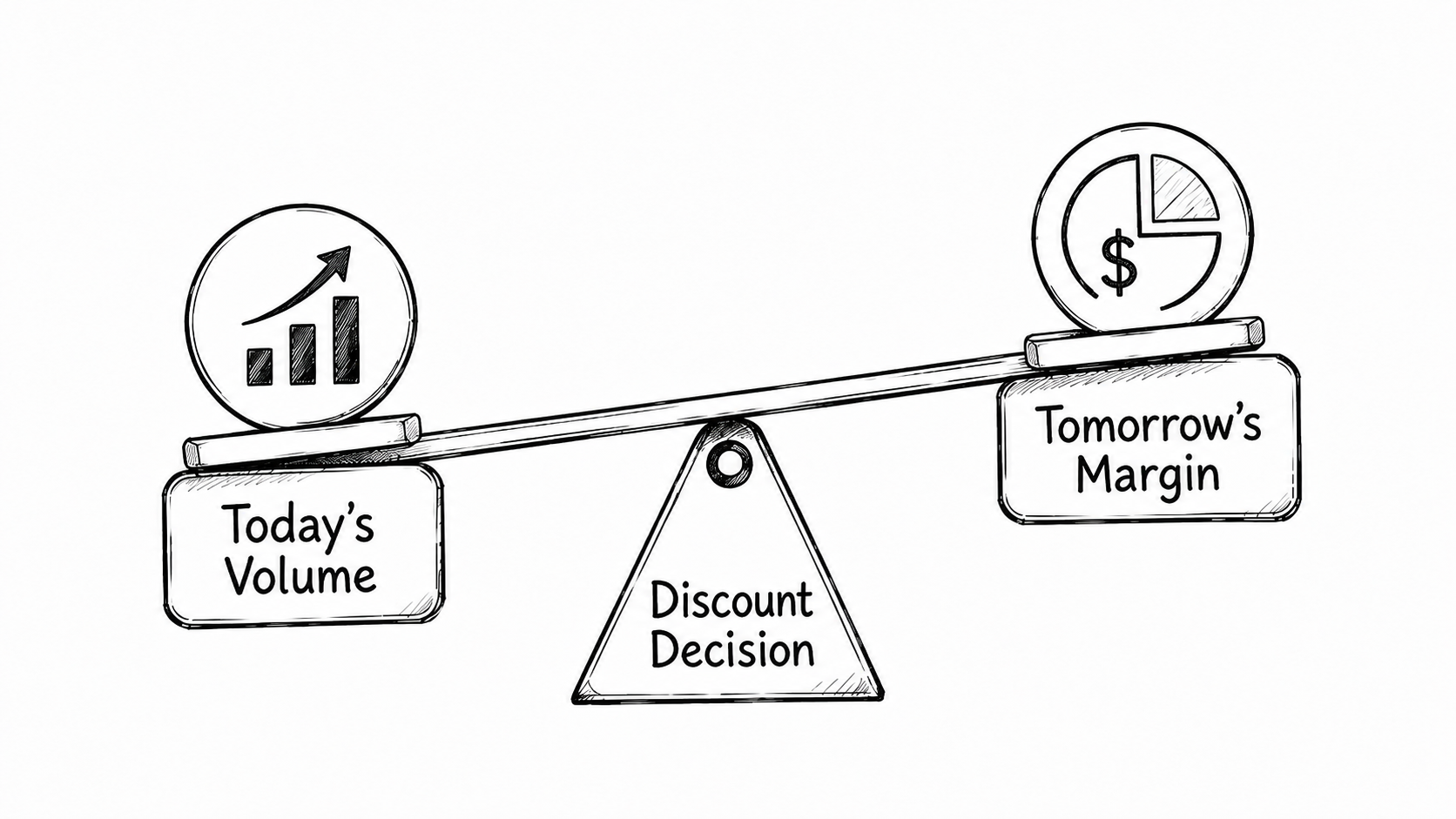
A discount is a signal
Most discount decisions look small when they happen: one dealer, one product, one region, one quote. A dealer asks for a better price, sales wants to win the order, pricing checks history, and someone approves or rejects the request. But the discount does not end when the quote is accepted. It changes the next conversation. The dealer remembers what was possible. Sales remembers what was approved. Pricing remembers where pressure worked. Finance later sees whether the volume was worth the margin given away.
The resource at stake is pricing power: the ability to sell at a healthy price without losing the customer. When pricing power is strong, the stated price anchors the conversation. When it is weak, every quote begins with pressure for a deeper concession. That is why discounting resembles overfishing: used carefully, it wins profitable demand; used carelessly, it consumes the pricing power needed for future growth.
Not every discount is harmful. Some protect strategic accounts, respond to real competition, clear aging inventory, or grow profitable demand. The better question is what signal the discount sends, and whether the business can live with that signal later.
The hidden tradeoff: volume, margin, and pricing power
That signal has an immediate reward. Orders increase, sales momentum improves, and the quote is won. The hidden cost appears later: margin quality weakens, dealers expect more flexibility, sales teams ask for more exceptions, and pricing teams lose confidence in the stated price. This is what makes discounting difficult: the reward is immediate, but the feedback is delayed.
That is why volume alone is not the right goal. Even profitable volume is not enough if the way it is won trains the market to expect deeper concessions. The better goal is profitable volume that preserves the company’s ability to price the next order.
The same discount can mean different things in different contexts. On one product, it may protect a relationship; on another, it may erase margin. On a predictable bulk order, it may be attractive; on an order with split shipments, expedited freight, or special handling, it may quietly destroy profit. The business is not choosing only between winning and losing a quote. It is choosing between today’s volume, today’s margin, and tomorrow’s pricing power.
How the system learns
Once the business is choosing between today’s volume, today’s margin, and tomorrow’s pricing power, the next question is what the system teaches everyone to repeat. Here, the system means the commercial environment around the quote: dealers, sales, pricing rules, approvals, incentives, margin targets, backlog, response time, and expectations. Dealers learn what to expect. Sales learns what gets approved. Pricing learns where pressure appears. Leadership learns from margin quality. Operations feels it through quote backlog and dealer satisfaction. When revenue, speed, approval rules, and margin targets point in different directions, people follow the path the system makes easiest. Over time, the system teaches behavior by making some actions easier, faster, or more rewarding to repeat.
Customer markets learn the same way. Some retailers have trained customers to wait for coupons or promotions. Others have struggled when they tried to remove discounts after customers had learned to expect them. More disciplined retailers try to avoid teaching customers to wait for the next deal. The point is not that discounting alone explains any company’s success or failure. The point is that repeated pricing signals teach future behavior.
Historical pricing data gives the business memory. Percentiles, customer history, product history, regional patterns, and prior approvals show what happened before. But memory is not judgment. If the system has learned bad habits, history can make those habits look normal. Data can reveal the pattern, but it cannot decide whether the pattern should continue. The system learns either way; the only question is whether it learns by accident or by design.
Understanding the system model
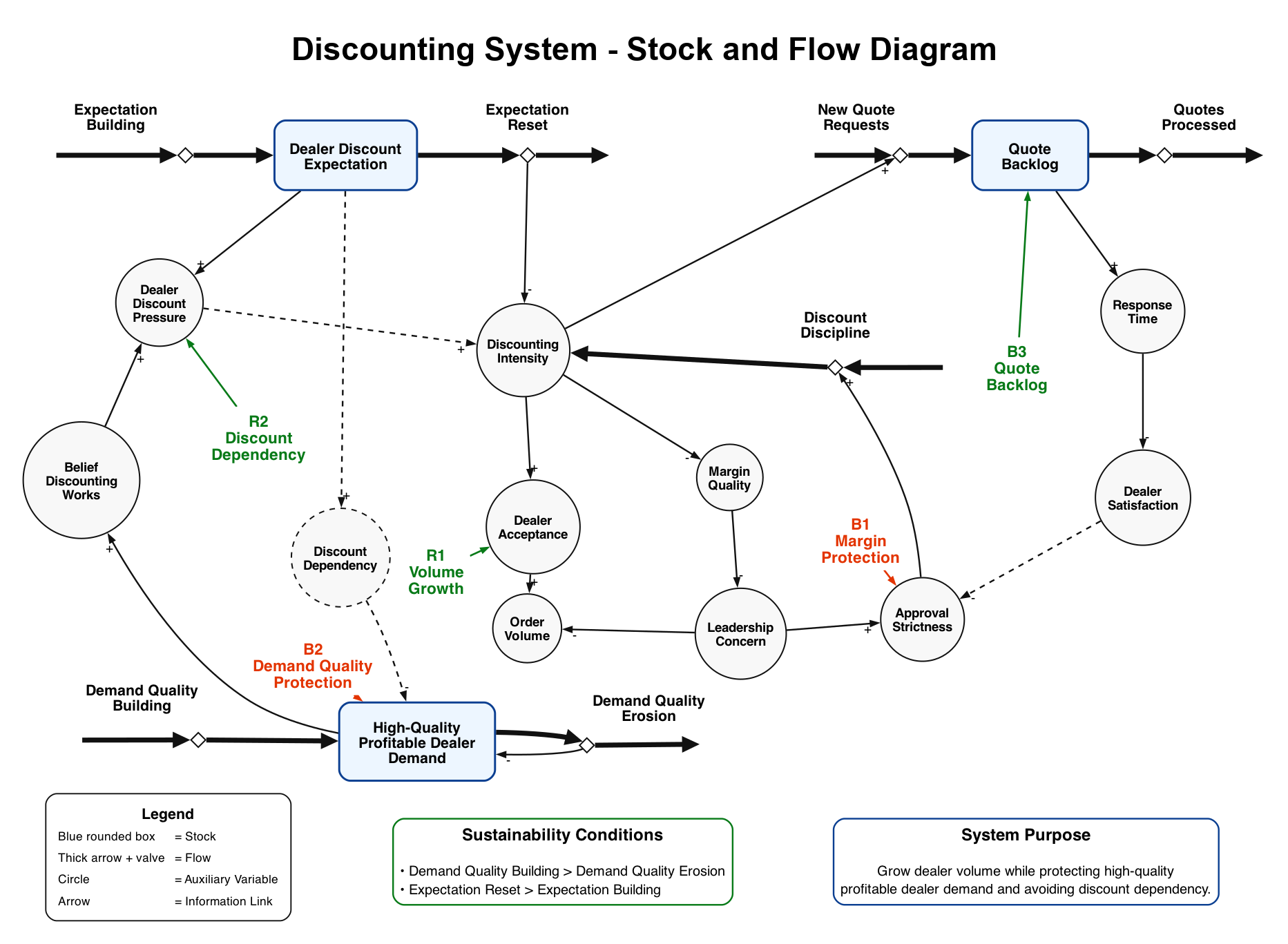
Figure 1 shows discounting as a stock-and-flow system. The blue boxes are stocks: conditions that build up or decline over time. Dealer discount expectation, high-quality profitable dealer demand, and quote backlog are not one-time events; they are slow-moving conditions shaped by repeated discount, approval, and response decisions.
The thick arrows are flows. Dealer discount expectation rises through expectation building and falls through expectation reset. High-quality profitable dealer demand grows through demand quality building and declines through demand quality erosion. Quote backlog rises with new quote requests and falls as quotes are processed. The system stays healthy only when rebuilding is stronger than erosion.
The circles show the forces that connect these stocks. Discounting intensity affects dealer acceptance, order volume, margin quality, and dealer discount pressure. Approval strictness, leadership concern, response time, and dealer satisfaction then feed back into future decisions. Pricing power is not shown as one box; it is represented through dealer expectations, discount pressure, margin quality, and high-quality profitable demand.
The green patterns show why discounting is attractive and why it can become self-reinforcing. R1 shows the short-term volume benefit. R2 shows the dependency risk: repeated concessions increase dealer expectations, which increase discount pressure, which can lead to more discounting. The red patterns show the correction forces: B1 protects margin, B2 protects demand quality, and B3 shows the operational cost of backlog and slower response. The model shows the tradeoff: volume can grow while pricing power weakens.
Use the simulator below to see how the same system behaves under different discounting conditions.
Interactive model
Pricing Power Simulator
Synthetic data, not a forecast. This version focuses on two loops: R1 Volume Growth and R2 Discount Dependency. Click Healthy, Discount, or Protect to start with a scenario. Then move one slider at a time.
Healthy balances growth and guardrails. Discount pushes for volume. Protect emphasizes pricing discipline.
Scenario outcome
The system is currently balanced. Volume, profitable demand, and pricing power remain within a healthier range.
Peak volume lift
+15.9
Profitable demand lost
0.0 pts
Pricing power lost
0.0 pts
How to read this
In Discount, order volume may rise first because quotes are easier to win. Then dealer expectations can build, profitable demand can erode, and pricing power can fall. The useful question is whether volume came from healthy demand or from training the market to need concessions.
Competition and economy are modeled as external forces. They can make discounting necessary, but repeated discounting can still become a habit that weakens future pricing power. The dashed line shows dealer expectation, the delayed signal behind discount dependency.
What leaders need to design
The model shows that leaders have several places to intervene, but not all interventions have the same leverage. The deepest question is purpose: is the pricing system designed only to win volume, or to win profitable volume while preserving pricing power? If the purpose is unclear, every other control becomes weaker. A business cannot protect pricing power if its workflow, incentives, and approvals still teach people to chase volume above all else.
The next leverage point is information flow. The tradeoff has to be visible before approval, inside the decision workflow. Decision-makers need to see history, margin quality, customer behavior, cost-to-serve, backlog pressure, and likely exception patterns inside the decision workflow. Software becomes useful when it brings these facts and consequences into view at the moment judgment is needed.
Rules and incentives come next. Pricing leaders can define what volume is worth winning. CIOs can connect data and workflow so the decision is not made in fragments. CTOs can make the logic explainable enough that users trust it. The goal is to change the conditions that make healthier discount decisions easier.
The visible tools are the outer layer: dashboards, approval thresholds, alerts, guardrails, and exception reports. They matter, but they work only when the deeper design is right. The system improves when the healthier path becomes the easier path.
A practical discount decision architecture
The leverage points become useful only when they are built into the quote workflow. A practical discount system should use history as one input, then apply quote context, business guardrails, risk, and the right approval path.
The historical benchmark gives the starting range. Similar dealer, product, region, order size, and prior quote behavior show what has been normal. But normal is not always healthy. Margin guardrails define what the business can afford. Cost-to-serve adjusts for freight, split shipments, special handling, rush orders, and service complexity. Dealer behavior risk shows whether the request is an isolated exception or part of a pattern that may reset future expectations.
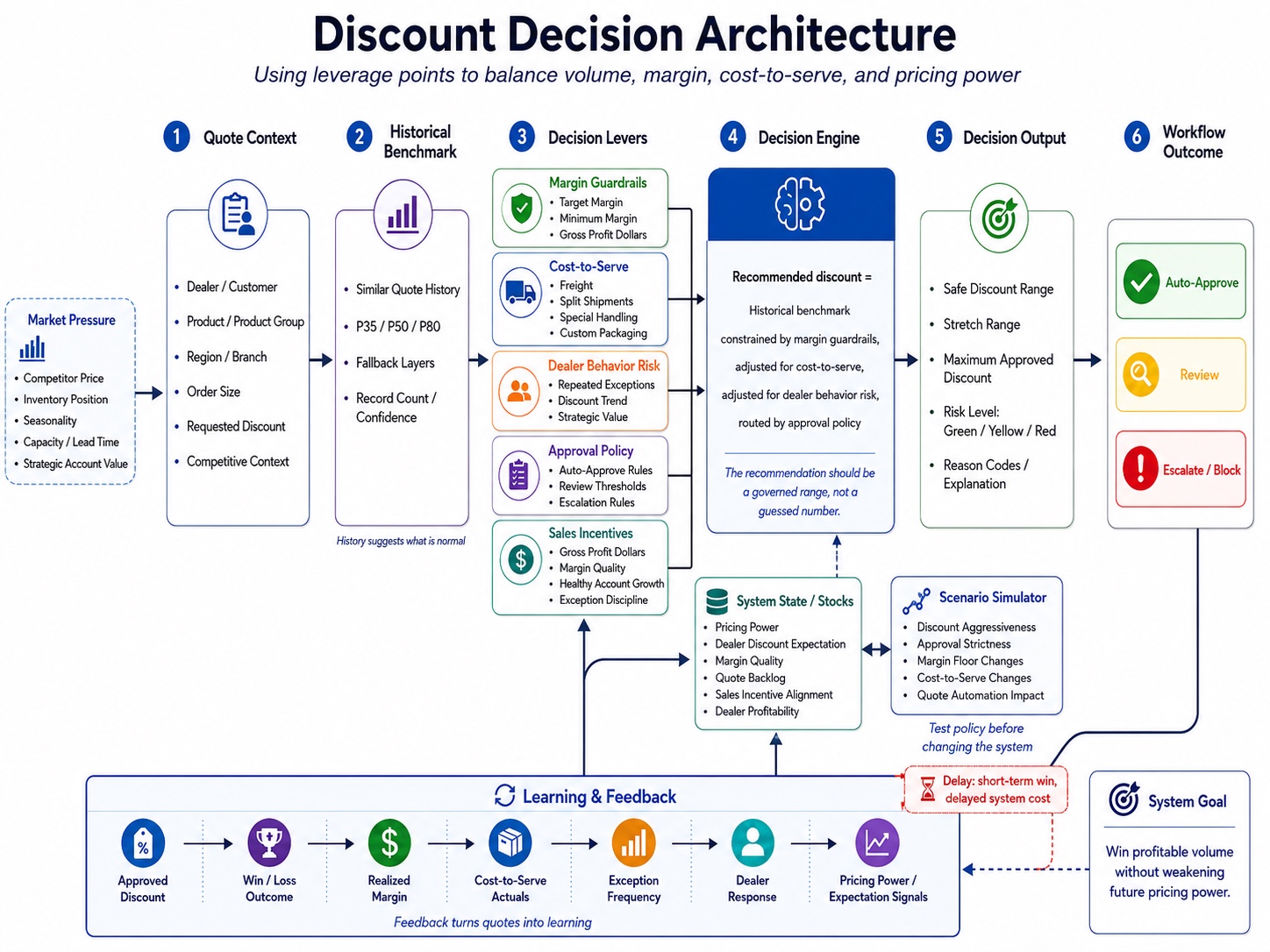
Figure 2 shows the architecture as a governed workflow. History suggests the range, margin sets the floor, cost-to-serve adjusts the economics, dealer behavior adjusts the risk, and policy decides whether the quote can be auto-approved, reviewed, escalated, or blocked. The output should include a safe range, a stretch range, a maximum approved discount, a risk level, and reason codes.
The goal is to recommend the safest discount that can win profitable demand without increasing long-term discount dependency.
Where pricing power is protected
Leaders should start at the highest-leverage point: the moment the discount decision happens. Make the tradeoff visible before approval. Align incentives with profitable demand. Remember exceptions. Learn from what happened after the quote was won or lost. That is where pricing power is protected or consumed.